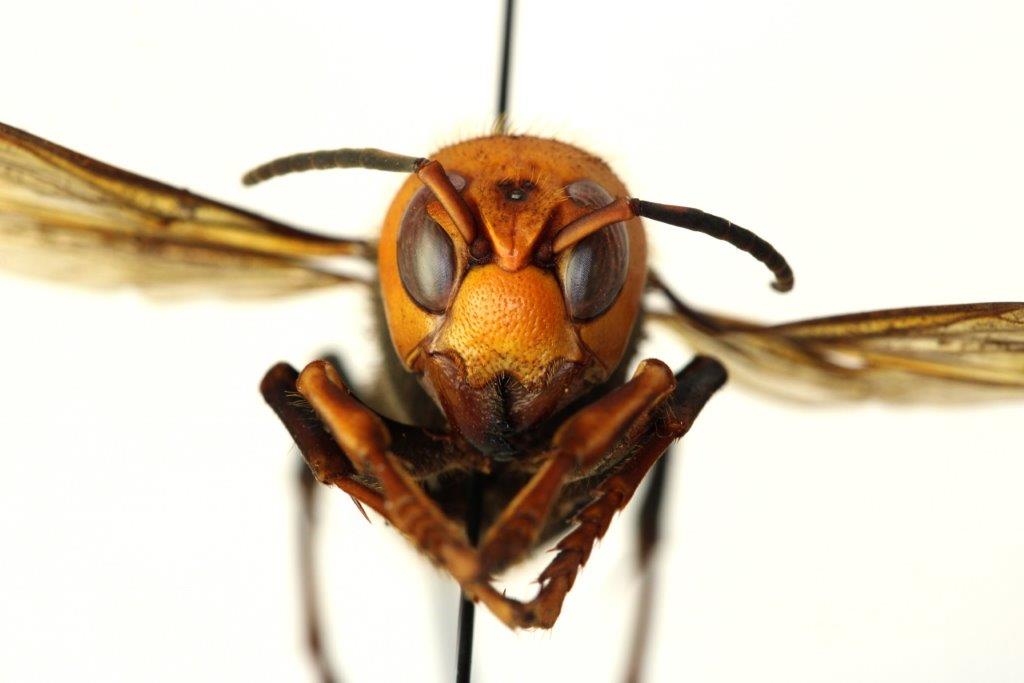
 The Asian giant hornet has recently been spotted close to the
Canadian border in Washington state. Photo courtesy Washington State
Department of Agriculture.
The Asian giant hornet has recently been spotted close to the
Canadian border in Washington state. Photo courtesy Washington State
Department of Agriculture.
Last year’s quiet arrival of a foreign wasp known as the Asian giant
hornet is no longer a secret outside of Washington state. Within the
past few days, all the major TV networks have
broadcast stories of the arrival of the wasp to the Pacific Northwest. Known to entomologists as
Vespa mandarinia, it has been named by the press the ‘murder hornet’.
It’s hard to argue with the name ‘murder hornet’ given that this wasp causes
30-50 human deaths a year in Japan. And the threat is serious enough that the Washington State Department of Agriculture has devoted
a website to the pest and
assigned public engagement officer, Karla Salp, to handle public
concerns. “Our hope is to eradicate it before it can get established in
Washington,” she said. “Barring that, containing it is our second
goal.”
Let’s face it, the thought of giant stinging wasps touches our
deepest fears. If proof was needed of how scary wasps are to most
people, look no further than the
Hunger Games and its “tracker jacker” wasps.
Even Hollywood knows the idea of being attacked by a swarm of wasps or
bees is horrifying in the most primal way (and therefore sells tickets).
How bad?
Given the fact that lots of other stinging wasps and bees are already
a part of the landscape in Texas, why the fuss? After all, it’s just
another wasp. One of the reasons the Asian giant wasp generates so much
attention is its size. At 1 1/2 inches long (queens up to 2 inches) it
is reportedly the largest wasp in the world. Its sting is excruciating
and, unlike the honey bee, it can sting repeatedly.
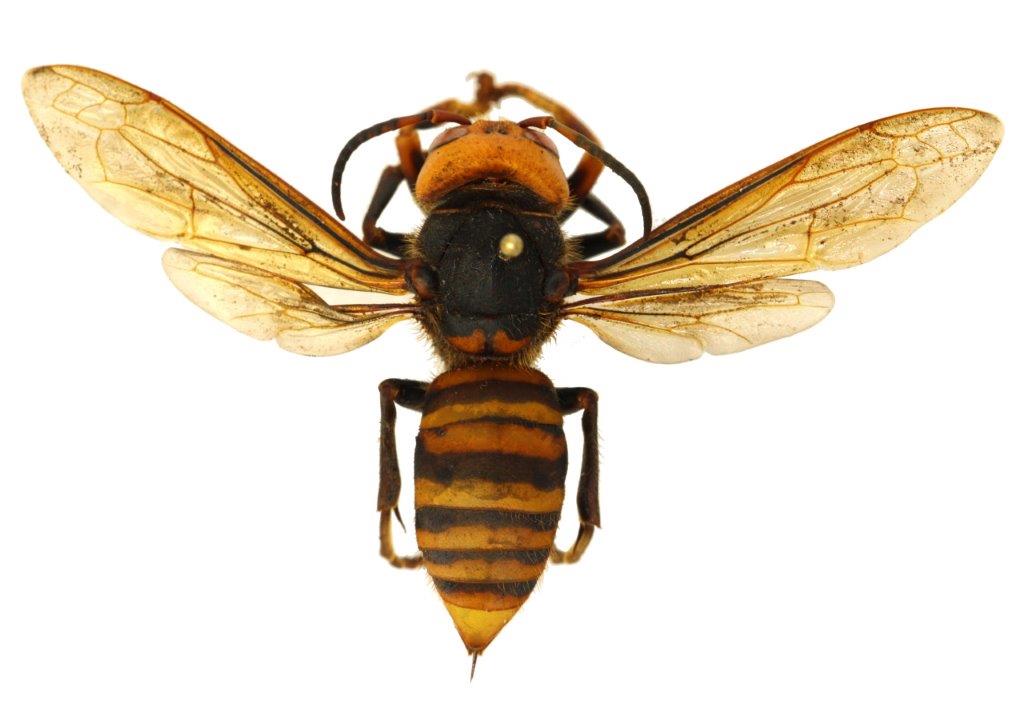
The
Asian giant hornet has a distinctive yellow-orange head and heavier
body than those of our largest native wasps. Photo courtesy Washington
State Department of Agriculture.
And while we’re talking bees, a gang of 30 Asian giant hornets can
take out a hive of 30,000 honey bees in a few hours. The European honey
bee–the predominant species used by beekeepers–lacks the behavioral
defenses that Japanese honey bees use against this wasp. With its giant
jaws capable of decapitating honey bee defenders, and a exoskeleton
impervious to bee stings, the giant hornet makes a formidable foe. To
make matters worse, beekeepers who encounter these wasps face
1/4-inch-long stingers that penetrate standard beekeeper garb.
Impact on Texas
The bottom-line is that the chance of Asian giant hornets invading
Texas soon is slim, given that at the moment only a few wasps have been
found in only one county in the far northwest corner of the U.S. Also,
hornets are less likely to be transported by humans than many other
exotic insects, like fire ants or emerald ash borers.
As with any social insect, hornets live and survive in colonies, not
as individuals. So an individual wasp that accidentally flies into a
vehicle and gets transported cannot survive away from its colony. The
only way to spread the wasp is by transporting an entire subterranean
nest, or to transport a (much rarer) previously mated queen, capable of
starting a new nest on her own.
Natural spread on the ground could certainly also occur, but it
should take much longer. In China the wasps seem to favor forested
areas and avoids high altitudes and open grasslands. Texas does not
seem to be ideal habitat for this wasp. Nevertheless, it’s hard to feel
completely safe from an insect that just successfully hopped an ocean.
And according to Salp there is genetic evidence that the Asian giant
hornet (against all odds) slipped into British Columbia not once, but
twice in the past year.
Look-alikes
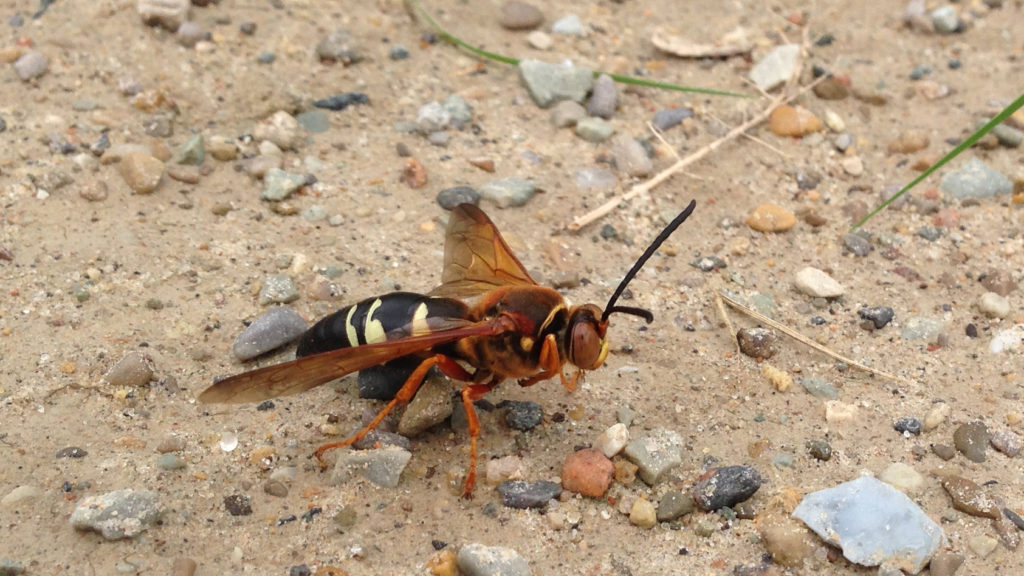
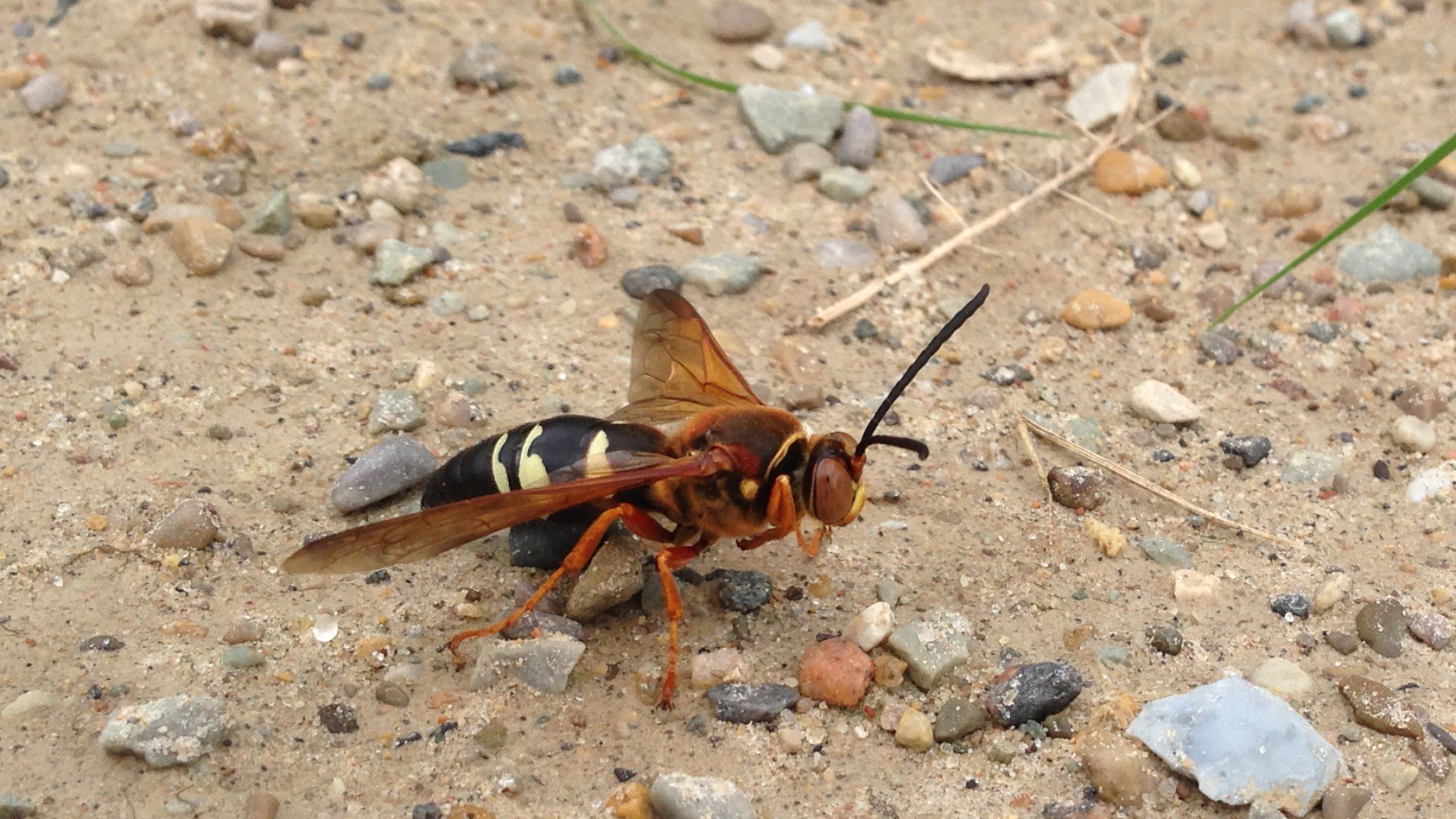
The cicada killer wasp, Sphecius speciosus, is another large wasp, approaching the length of the Asian giant wasp, common in Texas.
It’s not unusual when a scary new pest gets reported in the news for
everyone to start seeing them in their backyard (it’s a natural human
response to believe that if something bad is going to happen, it will
happen to us personally first). But in this case, there are much better
explanations for big hornets in your backyard. In Texas one of our
largest stinging insects is the
cicada killer wasp.
Cicada killers range in size from 1 to 1 1/2 inches-long, approaching
the Asian giant wasp in length. Although the bodies of cicada killers
are more slender, and heads not as distinctively orange, they are still
easily mistaken for the more sinister giant hornet.
Washington state officials are also responding to a worried public. “We have created
a chart to show people the size differences
in native bees and wasps compared to the Asian giant wasp,” said Salp.
“Its common to see other wasps and mistake them for the giant wasp.”
In Texas, it is highly unlikely that the Asian giant hornet will be
spotted for many years, if ever. But if you see something unusual, a
good picture is usually sufficient to roughly identify a bee or wasp.
Send the image to your county Extension office with a description of the
city and county and date where it was taken. Also, as accurately as
possible estimate the length of the insect. The better the picture and
description, the more likely you are to get an answer.
And, as for now, don’t watch the Hunger Games if you want to sleep well tonight.
-------------------------------------
Thanks Mike!
Blayne