Wednesday, November 20, 2019

Cotton Irrigation Timing Study released


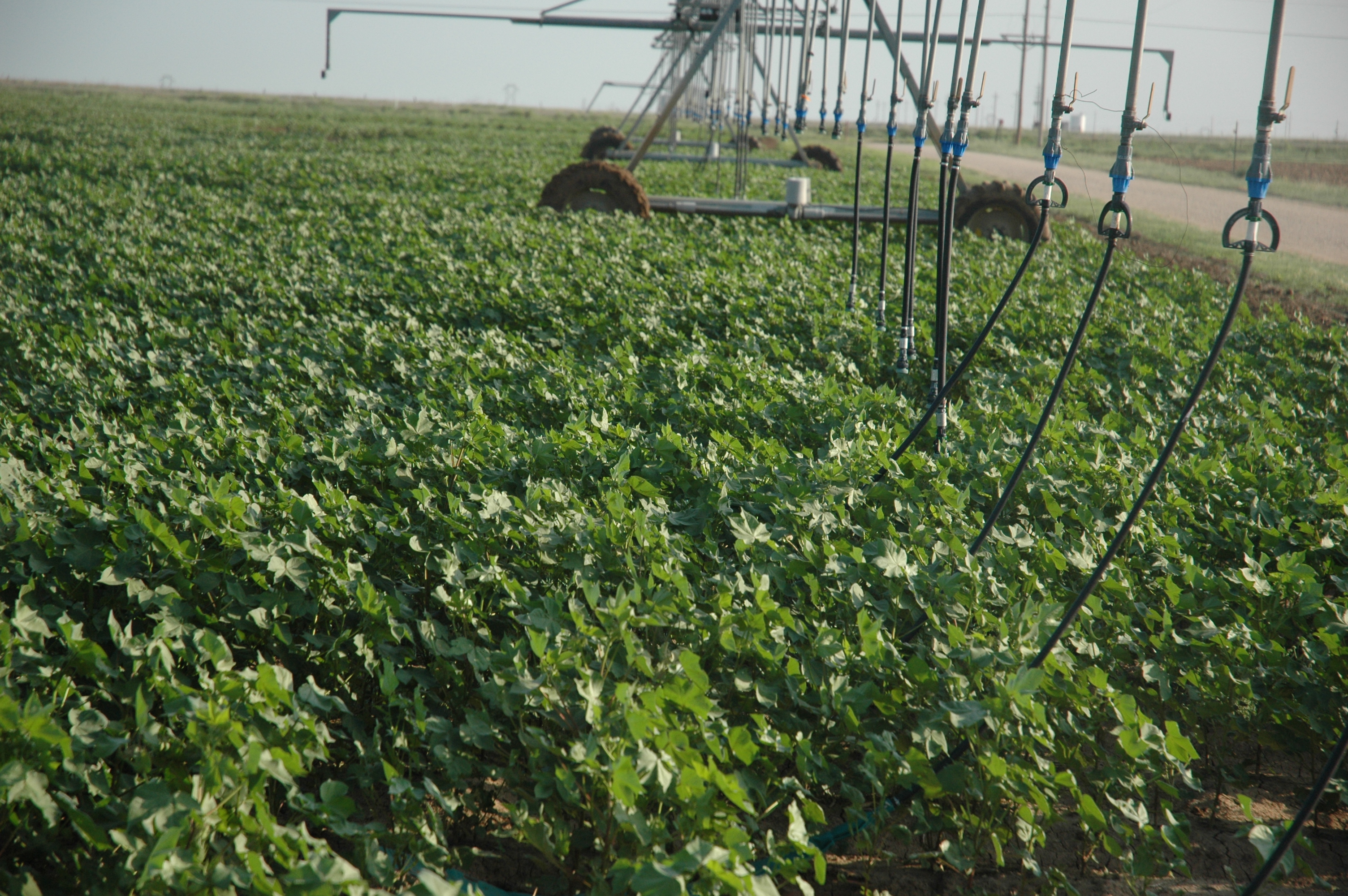
A Texas A&M AgriLife Research study looked at irrigation timing to maximize water-use efficiency and yields. (Texas A&M AgriLife photo by Kay Ledbetter)
 https://today.agrilife.org/wp-content/uploads/2019/11/cotton1-042.jpg

Cotton is sensitive to water stress at different growth stages, needing water at specific times to produce a high-yielding crop. A Texas A&M AgriLife Research study investigated the best strategies to improve irrigation water-use efficiency while maintaining high yields.
Evaluation of crop-growth-stage-based deficit irrigation strategies for cotton production in the Southern High Plains,” was authored by AgriLife Research scientists Srinivasulu Ale, Ph.D., geospatial hydrologist, and Sushil Himanshu, Ph.D., postdoctoral research associate, both in Vernon, and James Bordovsky, senior agricultural engineer, Halfway, along with and Murali Darapuneni, New Mexico State University.  The study was published in Agricultural Water Management Journal’s special issue on Managing the Ogallala.

Himanshu said the study should help farmers make better decisions that can result in higher seed cotton yields using the most efficient irrigation strategies. At the same time, these strategies will conserve the Ogallala Aquifer as a water resource for generations to come.

Researchers focused on irrigation strategies based on cotton’s five growth stages, with certain stages irrigated more and others less. The CROPGRO-Cotton module available in the Decision Support System for Agrotechnology Transfer Cropping System Model was used. This crop growth-simulation model allows testing and analysis of different irrigation scenarios.

The Southern High Plains are hot, dry and often windy with water shortages due to the region’s low rainfall and reliance on underground water. Cotton-boll size and count are greatly affected by the amount and timing of irrigation as well as rainfall and air temperature.

Additionally, water districts in the area have imposed restrictions on groundwater pumping to help conserve the Ogallala Aquifer. Depletion of the aquifer has been occurring at an alarming rate since the 1950s when farmers began large-scale water pumping for crop irrigation.

“Following the suggested strategies, farmers can have better control over crop growth and yield and enhance irrigation water-use efficiency,” Ale said. “The peak bloom growth stage was found to be the most sensitive stage to water stress and imposing water deficit during this stage resulted in the lowest seed cotton yield.”

Conversely, elimination of irrigation during the early and late-season growth stages had little effect on seed cotton yield and irrigation water-use efficiency.

“We also determined that reducing early season irrigation potentially increased cotton root growth,” Bordovsky said. “This helps plants have a stronger resilience to water shortages in later growth stages and increased seed cotton yield.”

Cotton Incorporated and the Ogallala Aquifer Program funded this study.
-30-


Find more stories, photos, videos and audio at http://today.agrilife.org


We grant permission for the use of this news as a free service to the
news media. Articles may be used either in their entirety or in part,
provided that attribution remains. You may use the stories and art, or
you may put the stories, art and/or news videos on your websites.
High resolution photos, audio and video also are provided with many of
our articles for your use at agrilife.org/today

Amarillo Farm & Ranch Show Dec. 3-4 (5 CEUs available)


AgriLife Extension offers educational programming, CEUs at Amarillo Farm and Ranch Show
Dec. 3-4 topics to include pesticides, healthy foods, markets, hemp
Writer: Kay Ledbetter, 806-677-5608, skledbetter@ag.tamu.edu
Contact: Megan Eikner, 806-373-0713, megan.eikner@ag.tamu.edu
Texas A&M AgriLife Extension Service family and community health agents from District 1 demonstrate healthy recipes and share them with the crowd during the 2018 Amarillo Farm and Ranch Show. (Texas A&M AgriLife photo by Kay Ledbetter)
The Texas A&M AgriLife Extension Service will once again be providing educational programming through several different events at the Amarillo Farm and Ranch Show Dec. 3-5 at the Amarillo Civic Center, 401 S. Buchanan St., Amarillo.
The doors open daily at 9 a.m. for the farm show, and admission is $2.
Panhandle Farm and Ranch Management Symposium
AgriLife Extension’s primary programming will be the long-running Panhandle Farm and Ranch Management Symposium from 8:30 a.m.-3 p.m. Dec. 3 in the Grand Plaza.
Registration is from 8:30-9 a.m., and the fee is $60. Lunch will be provided.
There will be five Texas Department of Agriculture continuing education units offered for pesticide applicators – one laws and regulations, one drift management and three general.
The program will feature the following topics and speakers:
– Weed Resistance, Scott Nolte, Ph.D., AgriLife Extension state weed specialist, College Station.
– Myths and Truths of Glyphosate, Nolte.
– Decline in Bt Traits, Suhas Vyavhare, Ph.D., AgriLife Extension cotton entomologist, Lubbock.
– Drift Control, Blayne Reed, AgriLife Extension integrated pest management agent, Hale and Swisher counties.
– Laws and Regulations, Kyle Thompson, Texas Department of Agriculture inspector, Lubbock.
For more information, contact Megan Eikner at 806-373-0713 or megan.eikner@ag.tamu.edu.
Healthy Living
AgriLife Extension’s District 1 family and community health agents will provide a variety of health-related information at their booth just outside of the Grand Plaza in the north foyer on Dec. 3-4.
They will provide different healthy food samples and recipes at 10 a.m., 10:30 a.m., 11 a.m. and 11:30 a.m. both days.
They also will share information on helping farmers, ranchers and their families manage stress and maintain a balanced lifestyle.
Economists Speak
Joe Outlaw, Ph.D., Texas A&M Agricultural and Food Policy Center co-director, College Station, and Mark Welch, Ph.D., AgriLife Extension grain marketing economist, College Station, will be a part of the annual Texas Wheat Symposium speaker lineup on Dec. 4.
The Texas Wheat Symposium, from 10 a.m.-1 p.m., will provide agricultural producers with current policy information, an outlook on the commodity market, and updates on other issues on the state and national level.
The symposium is free to attend and will conclude with the Amarillo Ag Appreciation Luncheon, courtesy of the Texas Wheat Producers Association and Amarillo Chamber of Commerce Ag Council.
Farm Show Private Applicator Training
The Farm Show Private Applicator Training on Dec. 4 will immediately follow the Amarillo Ag Appreciation Luncheon from 1-5 p.m.
This 3.5-hour training provides the information necessary to take the private applicator license test administered by the Texas Department of Agriculture. Cost is $70, and all materials will be provided.
“We encourage anyone living in the Texas Panhandle to participate if they need a private pesticide applicator license,” said Megan Eikner, AgriLife Extension agriculture and natural resources agent for Potter County.
The private pesticide applicator license is for agricultural producers and landowners who apply restricted-use pesticides to their own property.
Hemp Update
AgriLife Extension agronomist Calvin Trostle, Ph.D., Lubbock, will participate in the First Things: Considerations for Industrial Hemp Production in Texas, which is scheduled from 2-4 p.m. on both Dec. 3 and Dec. 4 in the Hospitality Room of the Civic Center.
Trostle will outline the issues facing a potential Texas hemp industry for fiber, grain and cannabinoid, CBD, production. He also will provide more resources for producers considering hemp.
-30-


Find more stories, photos, videos and audio at http://today.agrilife.org


We grant permission for the use of this news as a free service to the
news media. Articles may be used either in their entirety or in part,
provided that attribution remains. You may use the stories and art, or
you may put the stories, art and/or news videos on your websites.
High resolution photos, audio and video also are provided with many of
our articles for your use at agrilife.org/today

Friday, November 8, 2019

Survey ending Monday!


For those of you that have completed our annual Hale & Swisher online survey, thanks so much!  Responses have been outstanding and we will try to keep it up for next year.

If you have not, please do so!  We will keep the link open until  8 am Monday, November 11th.  Hope to hear from you, link below:


Thanks,

Blayne