A
heads up for any of you growing strawberries or blackberries out there… This
new aphid might be something to watch for in early spring.”
Thanks,
Blayne
Reed
EA-IPM
Hale & Swisher
225
Broadway, Suite 6
Plainview,
TX 79072
Office
- 806-291-5267
Subject:
Adventive Aphid and Natural Enemy Found in Mississippi
|
|
|
|
ARS News
Service
|
|
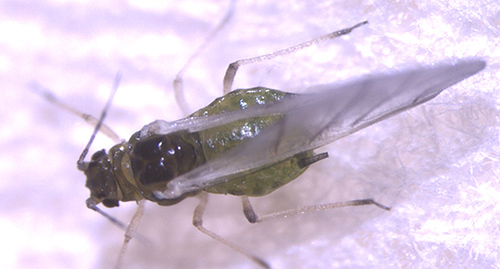
Aphis ruborum
adult.
Adventive Aphid and Natural Enemy Found in Mississippi
Agricultural Research Service (ARS)
scientists and their colleagues have discovered, for the first time, an
adventive—meaning it just arrived in a new locality—aphid species as
well as an associated parasitoid wasp on strawberry plants in
Stoneville, Mississippi.
While sampling for plant pests and natural enemies, Eric
W. Riddick, a research entomologist with the
ARS Biological
Control of Pests Research Unit, found the aphid, Aphis ruborum,on
cultivated strawberries in his research high tunnels—unheated
greenhouses. It's not supposed to be here, he said. The species
has spread in Europe, north Africa, India, Pakistan, Chile, Argentina,
western United States (Washington state) and Canada.
The aphid was found predominately on newly emerged, not
fully developed leaflets of daughter strawberry plants in 2016, Riddick
said. By 2017, aphids were observed on fully developed leaflets on
mother plants. The occurrence of A.
ruborum in
Mississippi represents a new state record and the eastern-most
established record in the United States, he added.
The study, recently published in the Journal
of Insect Science, cites
another discovery. In 2017, Riddick found mummified aphids, which
signaled that a parasitoid wasp, Aphelinus
varipes, had attackedthe aphid. The tiny wasp, which is a
beneficial insect, is not known to attack this species of aphid.
This is first time an attack by the A. varipes waspon
the A. ruborum aphidhas
been documented anywhere in the world, Riddick said. The wasp layseggs
that develop inside the aphid, killing it. ARS scientists in
Beltsville, Maryland, identified the aphid, and non-ARS colleagues at
the University of Georgia and Agriculture
and Agri-Food Canada identified the
parasitoid wasp, using molecular techniques.
The aphid seldom uses cultivated strawberry as a host
plant, Riddick said. However, it frequently attacks blackberries,
damaging foliage. As it feeds, the aphid also injects a virus, which
can cause plants to wilt and die.
The next step is to figure out where the aphid came
from. It is possible that previously undetected populations of the
aphid have survived on uncultivated plants (such as wild strawberry,
dewberry or blackberry) in the landscape surrounding Stoneville.
Riddick plans to conduct a small-scale sampling for the aphid on wild
plants in areas around Stoneville and study the rate at which the aphid
is being attacked by the parasitoid.
The Agricultural
Research Service is the U.S.
Department of Agriculture's chief scientific in-house research agency.
Daily, ARS focuses on solutions to agricultural problems affecting
America. Each dollar invested in agricultural research results in $20
of economic impact.
|
|
|
|
U.S. DEPARTMENT OF AGRICULTURE
Agricultural Research Service
|
|
|
|
Stay Connected with the USDA Agricultural
Research Service
5601 Sunnyside Avenue, Beltsville, MD 20705
|
|
|
|
|